Now that Audio Aviators has added a few niche services for the amateur radio community, I'm always on the lookout for tools that can make ham radio more accessible, productive, and fun. I've been deeply involved in broadcast media technology, and lately I've taken on a few hands-on ham radio projects — antenna builds, GPSDO time standards, repeater work, vintage gear restoration. That's why the recent launch of HAMgpt (at hamgpt.co) caught my attention right away.
What is HAMgpt?
HAMgpt bills itself as your personal amateur-radio copilot. Unlike a general-purpose AI, it's designed specifically for hams: it takes your license class, radio, antenna, location (QTH), and live band conditions into account to give practical, real-time answers to the question, “What can I do with my radio today?”
Key capabilities include current band openings and who you can realistically work from your location, nearby repeaters with accurate offsets and CTCSS/DCS tones, live DXpeditions and POTA/SOTA spots within reach of your setup, satellite pass predictions, license privilege lookups by class and country, antenna design suggestions with real dimensions, and exam practice.
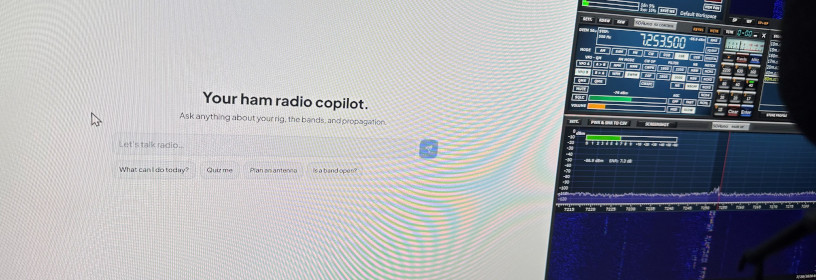
It emphasizes how it pulls real data from sources like FCC databases, spots, and space weather instead of hallucinating frequencies or privileges the way a generic chatbot sometimes does. It supports US FCC licenses (Tech, General, Extra) plus several other countries. Still, it's always best to double-check responses — especially when dealing in a regulated area.
My Perspective as a Long-Time AI User
For many months now, I've relied on Grok (from xAI) as my go-to AI technical assistant — for Audio Aviators content creation and engineering projects, diagnosing or repairing vintage tube audio gear, and building test setups for ham radio. Grok has been a solid and capable frontier model, and it's only become better at handling a wide range of creative and technical tasks with speed and depth. I also recently began using Claude (from Anthropic) for its coding power and design help, and it's been a proverbial game changer for efficiency.
“A specialized tool that deeply integrates ham-specific data and personalization could shine in niche, on-air decision-making scenarios — while a powerful generalist excels at broader engineering, research, and content creation.”
Jon P. Simpson — Audio AviatorsIt will be interesting to see how a purpose-built service like HAMgpt performs by comparison. I look forward to testing both side by side as tools in the kit.
Free Tier and Subscription Details
HAMgpt offers a free tier with basic access — you can preview it on the homepage without an account, and a free account unlocks personal questions. Optional paid plans provide higher daily usage limits and additional personalized features. Specific pricing isn't prominently listed on the site yet; likely still early in the launch phase, but it follows the common freemium model seen across many AI tools.
Early Buzz and Reviews
The service launched mid-July, so comprehensive long-term reviews are still emerging. Early mentions on ham radio sites, Reddit's r/HamRadio, Hackaday, and X are generally positive — users appreciate the focused, non-hallucinated responses tailored to real station data and live conditions. It's being described as a “digital Elmer” that knows your setup.
I haven't signed up yet myself but plan to give it a try soon and maybe share my hands-on impressions in a future post. If you've used HAMgpt already, drop a comment or reach out — I'd love to hear how it works for you.
Looking Ahead for Audio Aviators
Tools like this highlight how AI is becoming a powerful ally for amateur radio operators and content creators alike. Whether it's daily operating decisions, technical projects, or simply expanding your knowledge base, the combination of specialized and frontier models opens up exciting possibilities.